

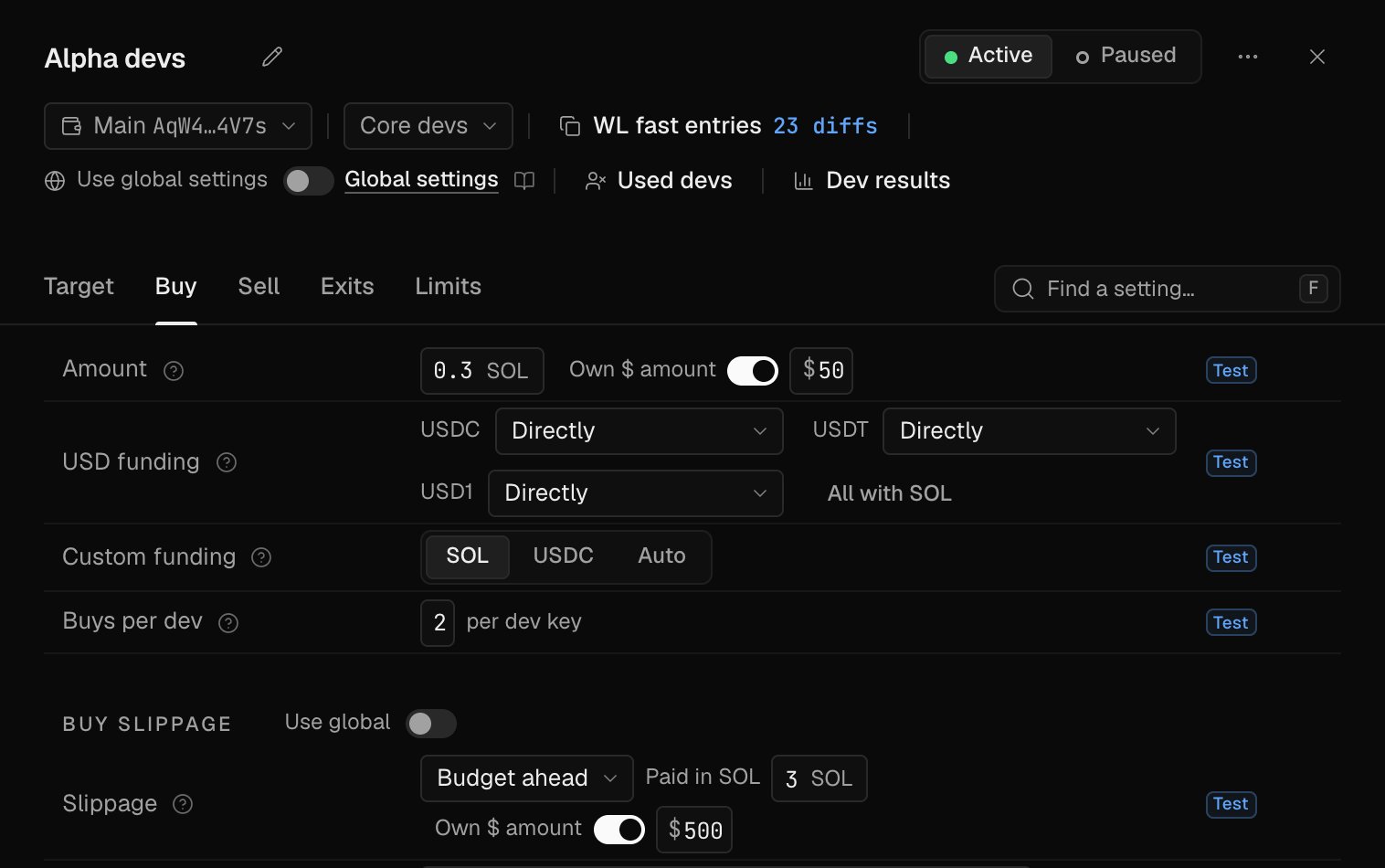
Every trading setting on this tab carries a Test badge: “We’re still testing this setting on live trading. It works; if anything looks off, tell the LaserCat team.”
Traders and Space Admins edit this tab. A Viewer sees it read-only.
Buying
There is no buying switch: the job’s state decides whether it buys. Only a job saved with buying off shows a Buying row, “Off: decides, never buys”, with Turn buying on. The panel’s advice: “To stop buying, pause the job instead.”Amount
- Amount: the SOL amount, for SOL coins.
- Own $ amount: a fixed dollar amount for coins quoted in USDC, USDT, or USD1. Switched off, they are bought for the SOL amount at the shared SOL price, in whole cents, and the row reads, for example, “from SOL: about $15.00”. Point at it to see the price used and how old it is.
USD funding
Snipe and copy jobs. For each stablecoin’s coins (USDC, USDT, USD1):- Directly: with the dollar amount, from the wallet’s own USDC, USDT, or USD1.
- Through SOL: with the SOL amount, through the router. No stablecoin needed; it is a SOL position, sold back to SOL.
Custom funding
Snipe and copy jobs. A custom quote is any quote but SOL, USDC, USDT, and USD1, such as an xStock, PUMP, or ORE. Its coins are bought through the router, paid with:
With USDC or Auto, set a real dollar amount first: “with USDC or Auto, a new job’s $0.02 buys $0.02 of USDC”.
Buys per dev
Snipe only. “How many times one dev is bought before the job stops buying them. 0 = no cap.” A change is structural and applies in about 60 s.Slippage
- Budget ahead: how much others may buy before us. It has two amounts, and a buy is held to the one in the currency it pays, never both:
- Paid in SOL: for the buys the job pays in SOL: a SOL coin, a USD coin bought through SOL, a custom quote’s coin bought with SOL.
- Own $ amount: a fixed budget for the buys the job pays in dollars: a USD coin bought directly, a custom quote’s coin bought with USDC. Switched off, such a buy takes the SOL budget at the shared SOL price, in whole cents (“from SOL: about $…”).
- Percentage: how far the price may move.

Fees per send path
Each buy goes out as two copies, and at most one of them lands. Each copy has its own Priority fee and Tip.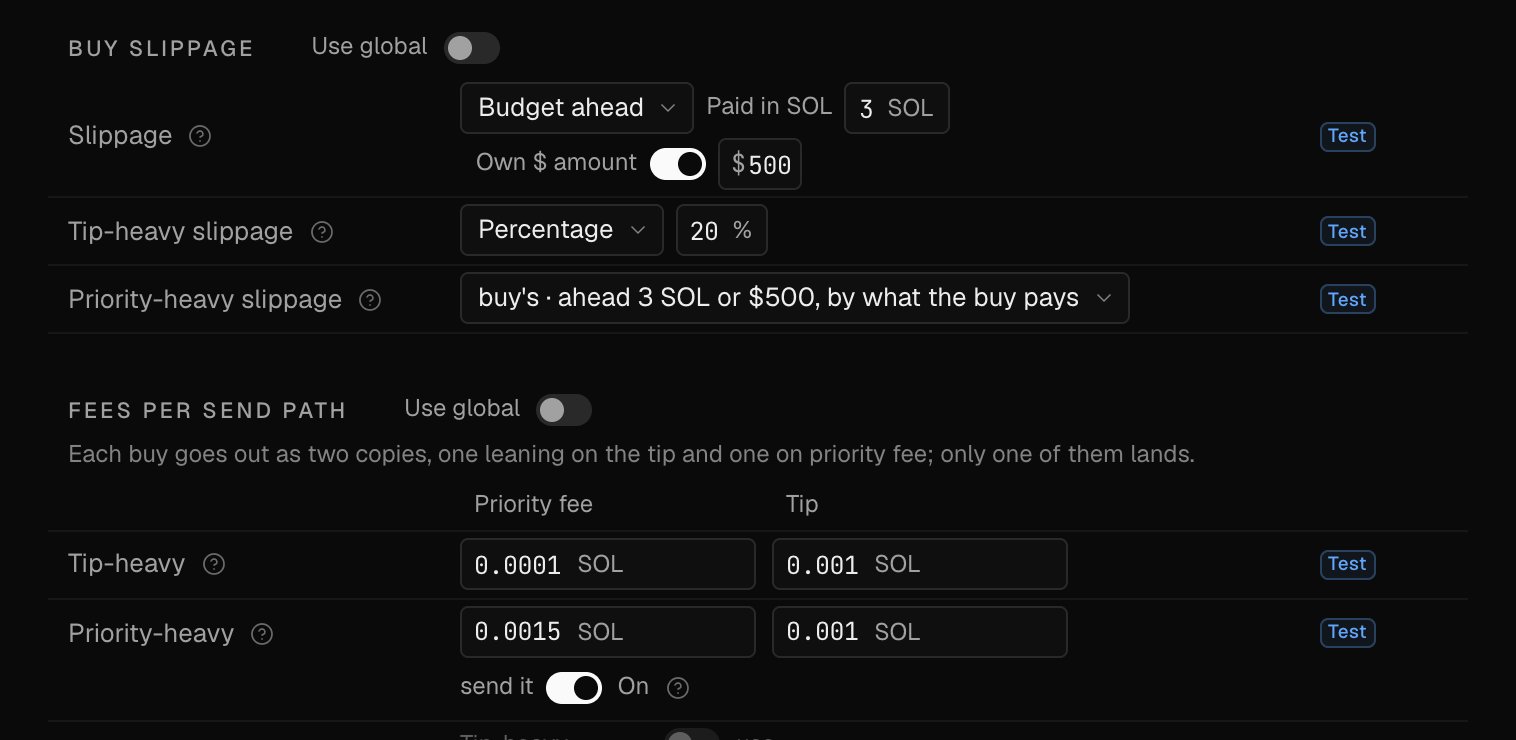
- Tip-heavy pays mostly a tip.
- Priority-heavy pays mostly priority fee, plus its own Priority-heavy tip. Leave that tip empty to pay the minimum.
- Priority-heavy copy switched off sends every buy as the tip-heavy copy alone: “its fees must land the buy”. The priority-heavy fees are kept for when you switch it back on.
- custom slippage, under each copy’s fees: Buy’s slippage (the default, shown with its value), Budget ahead, or Percentage. Each copy lands at its own price, so you can pair a tight tip-heavy copy with a wider priority-heavy one. A copy’s least output is the larger of what its own slippage gives and the buy’s minimum tokens.
Fees after a DBC fee wait and on 3-hop routes
Two rows under the fees per send path give a buy other fees in two cases: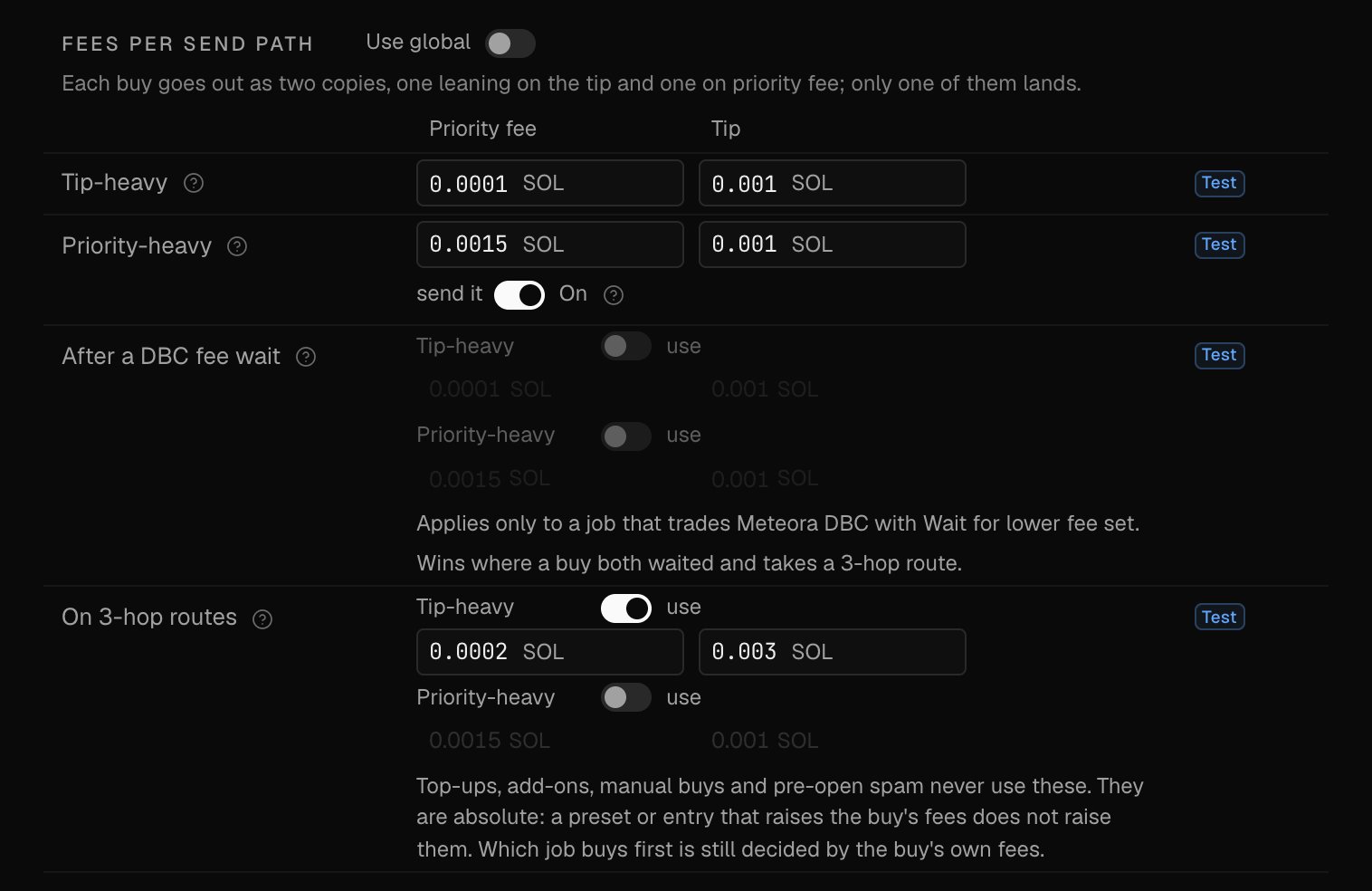
- Each copy, Tip-heavy and Priority-heavy, has its own use switch. Off, the copy pays the buy’s own fees, shown greyed in its fields. On, it starts from the buy’s own fees of that copy: set its Priority fee and Tip. The priority-heavy tip left empty pays the minimum tip.
- Where a buy both waited and takes a 3-hop route, After a DBC fee wait wins: “Wins where a buy both waited and takes a 3-hop route.” A copy it leaves off takes the 3-hop row’s copy on such a buy, else the buy’s own fees.
- These fees are absolute: “a preset or entry that raises the buy’s fees does not raise them.” Which job buys first is still decided by the buy’s own fees.
- Migration top-ups and a copy job’s add-ons never use them.
- While the priority-heavy copy is off, its fees here are greyed and kept for when it is on.
Migration buys
Snipe only. “After a targeted dev’s coin (or a named mint) migrates, buy the rest of the planned amount on its pool. Never for any-dev matches.”
With a top-up mode and Migration sell both on, the row warns “Migration sell wins: this job never tops up.”
Curve end
A row in the Execution section: how a buy on a Pump curve meets the curve’s end.- Tight, the default: a buy that others’ buys push to the end fails there. That failure counts against neither the fail streak nor the dev rules.
- Fill: the buy keeps room to go past the end, and buys what the curve has left at no more than its price under the slippage.
Route and hop slippage
Snipe and copy jobs. A coin of a custom quote (an xStock, PUMP, ORE), or a USD coin bought with SOL, is bought through the router: first the hops swap SOL into the coin’s quote, then the coin is bought. The Route section decides which routes such a buy accepts, and Hop slippage how much the hops may under-deliver. Neither touches a coin bought directly.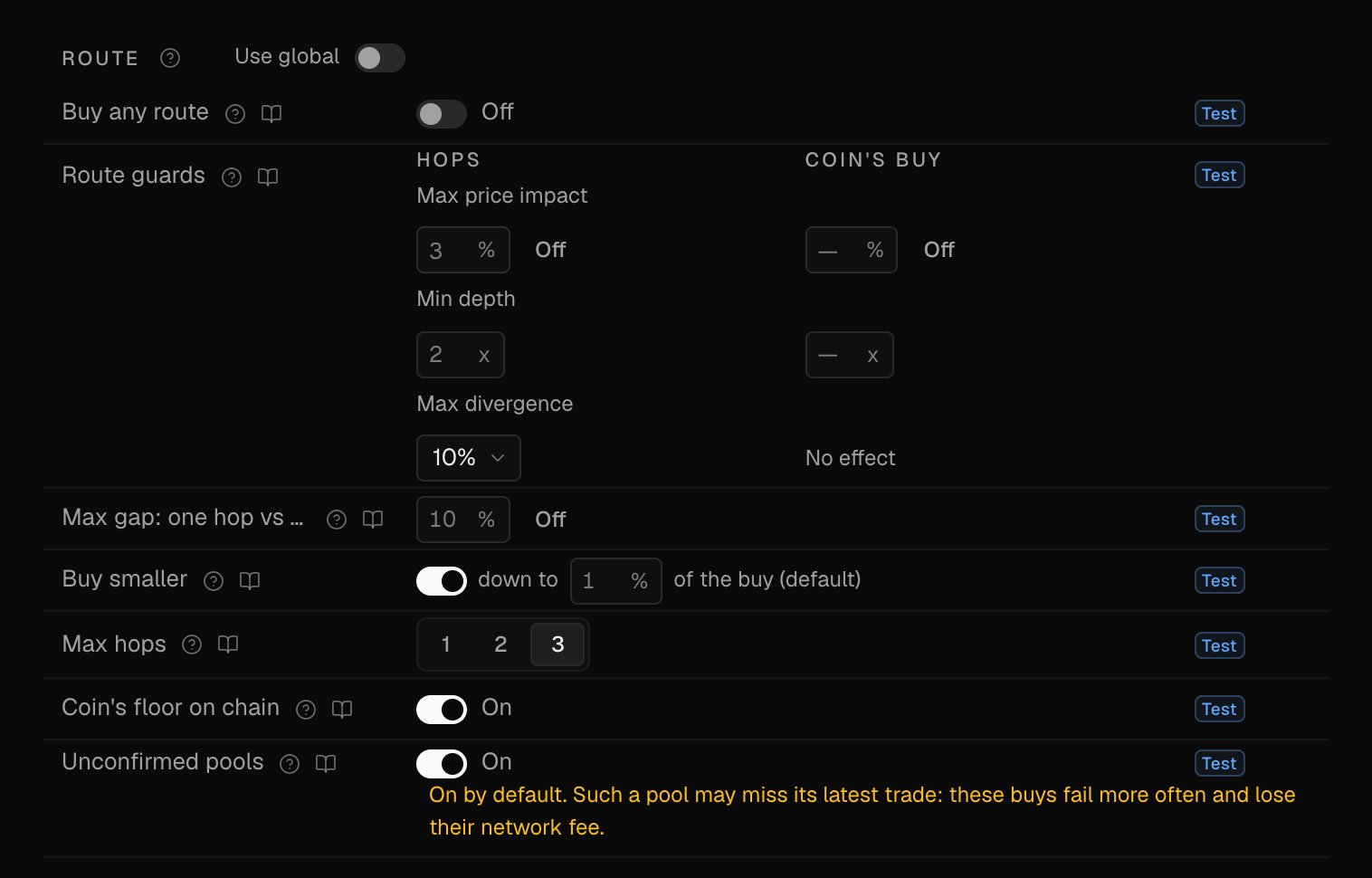
- Buy any route: On lifts every guard below; the buy takes whatever route is found.
- Route guards: price impact, depth, and price divergence on the hops and on the coin’s buy.
- Max gap: one hop vs two, Buy smaller, Max hops, Coin’s floor on chain, Unconfirmed pools.
- Hop slippage: Route’s own (0.5% for one hop, 0.75% for two), Percentage from 0 to 100%, or SOL ahead.
Next
Sell settings
Slippage, fees, dust, and the moonbag.
Exits
When positions sell by themselves.